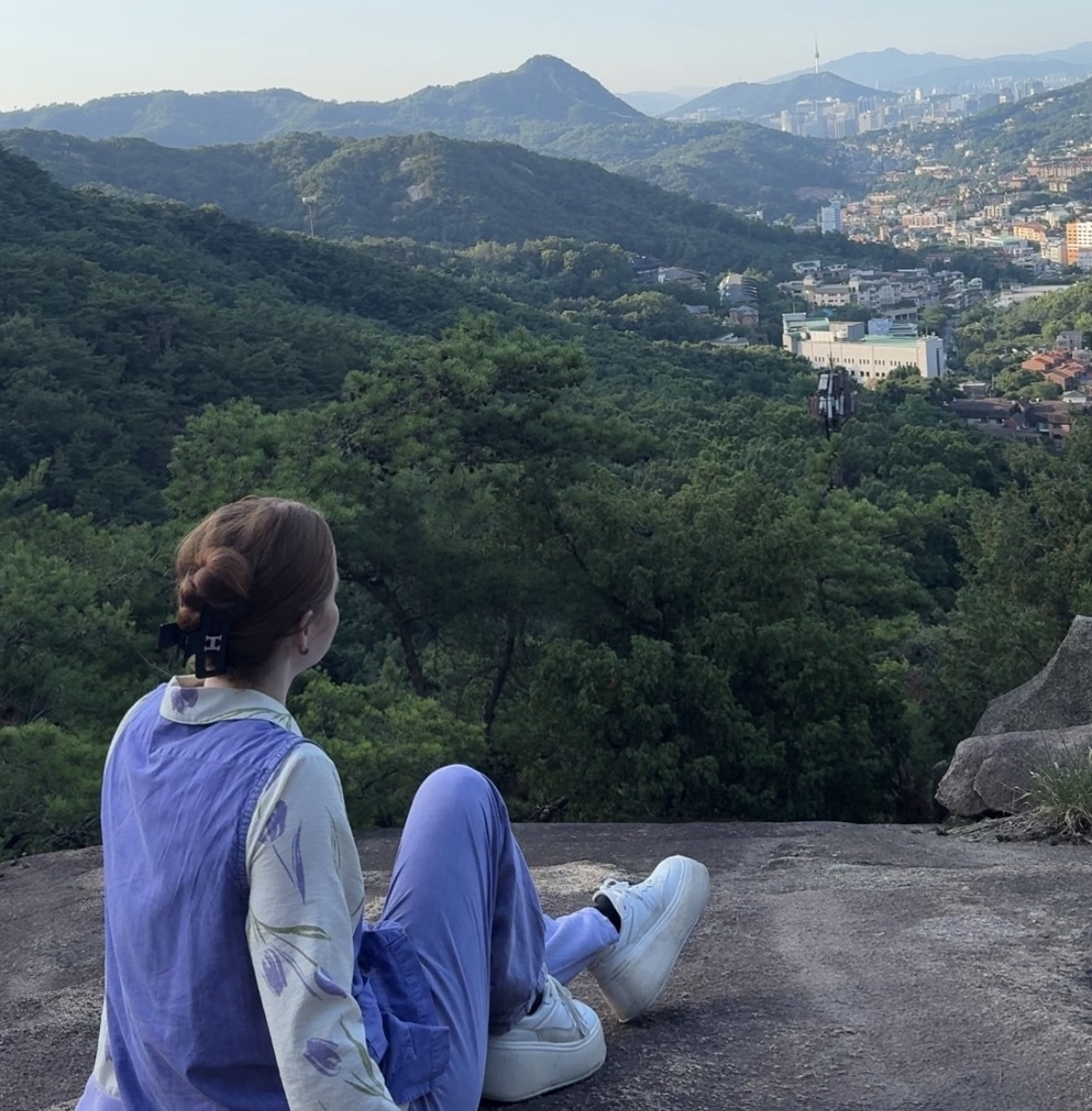
My first solo trip was South Korea.
Not a nearby city. Not a soft little weekend test run. South Korea — because apparently my personal growth likes to skip the beginner level and go straight to international logistics with a language barrier.
It wasn’t even the plan. I was supposed to fly standby with my mom and sister, and they couldn’t get on the flight. So I had a choice: cancel, wait, or go by myself and let them meet me a few days later.
I went.
Was I calm? Absolutely not. I worried about safety. About navigating. About eating alone. About whether I’d feel awkward, lonely, embarrassed, or suddenly incapable of functioning despite being a grown woman with a mortgage and a passport. I worried, briefly, about being kidnapped, because apparently my anxiety enjoys creative writing.
Very normal. Very relaxing. Very “just trying to become my best self while mildly panicking in an airport.”
But I’d already been to Japan, which felt extremely safe, and I’d researched Seoul enough to feel comfortable with the actual risk. Strong public transit. English-friendly signage. Plenty of structured activities. A reputation for being safe.
So I went. And that trip changed what felt possible.
Here’s what it taught me: your first solo trip does not require you to be fearless. It requires you to be prepared. Nervous doesn’t mean incapable. It means your brain would like a plan.
Maybe you’ve felt this too — the wanting and the bracing at the same time. This post is the plan. Let’s build it.
Your first solo trip is not the time to be interesting
The time to be interesting is later, when you casually mention over drinks that you navigated Seoul alone.
Your first solo trip is not the moment to prove how adventurous, spontaneous, or culturally sophisticated you are. It’s the moment to stack the deck in your favor.
So I wouldn’t pick the most logistically complicated destination on your dream list. This is not the time to star in an indie film where no one has cell service and every bus schedule is a rumor. Pick somewhere that makes the first attempt easier.
For a first solo trip, a good destination usually has a few things going for it:
- Strong public transportation
- A reputation for safety
- Enough English support to function
- Safe, well-reviewed lodging in a convenient area
- Easy access to food
- Activities you can book in advance
- Neighborhoods where you can walk around without feeling constantly on edge
That’s why Seoul worked so well for me. It gave nervous first-timer me exactly what I needed: strong transit, English-friendly signage, easy food, structured activities, and a level of everyday safety that felt noticeably different from a lot of U.S. cities.
It didn’t make me fearless. It made me functional. That was enough.
Your first solo trip isn’t a test of how brave you are. It’s a confidence-building exercise. The destination should support the version of you who is trying something new — not audition you for a survival show.
There are places I personally wouldn’t choose first, because of safety concerns, hard logistics, a major language barrier, or cultural attitudes toward women that could make the experience more stressful than empowering. That doesn’t mean those places are off the table forever. It means I wouldn’t make them the first rep.
A few destinations that make the first trip easier
If you want a shortlist, here’s where I’d point a nervous first-timer. (Difficulty is my own rough read — how much the logistics fight you, not how good the trip is.)
- Seoul — Difficulty 2/10. Extremely safe, intuitive transit, easy to navigate once you get your bearings. Great for cafés and quiet solo confidence.
- Tokyo — Difficulty 3/10. Incredibly safe, deeply organized, and surprisingly solo-friendly. Possibly the easiest place on earth to eat alone.
- London — Difficulty 2/10. Feels international without feeling unfamiliar. No language leap, which takes a whole category of worry off the table.
- Amsterdam — Difficulty 3/10. Compact, walkable, easy logistics.
- Copenhagen — Difficulty 3/10. Calm, safe, organized. Low-stress by design.
- Singapore — Difficulty 2/10. Clean, intuitive, very safe, and excellent for food.
The point isn’t the specific city. It’s the principle: choose a country that makes success easier.
Stay central, even if the room is smaller
For a first solo trip, I care a lot about where I sleep.
A cheaper hotel gets expensive fast if it costs you time, stress, long transit transfers, or the feeling that you don’t want to walk back after dark. I’d rather have a smaller, simpler room in a safer, better-connected area than a bigger, cheaper place that makes every single day harder.
For solo travel, I want to be:
- Close to public transit
- In a well-reviewed neighborhood
- Near food and coffee
- Somewhere I can return to mid-day for a reset
- Somewhere that doesn’t require me to become an amateur cartographer after 9 p.m.
You can always wander farther. You cannot easily teleport home when you’re tired, overstimulated, or slightly lost. Location isn’t just convenience. It’s nervous-system management. And frankly, I support that.
Book one structured activity early
One of the best things I did in Korea was book guided activities near the start of the trip. I did an e-bike tour around Seoul and a market tour. On another trip, I did an overnight Buddhist temple stay.
Those activities helped me feel included, oriented, and less alone. Instead of wandering a huge city pretending to be carefree while quietly wondering if I was lost, I had someone showing me around. I could ask questions. I could meet other travelers. I could get a feel for the place before navigating it solo.
This is one of my favorite tips for first-timers: book something structured near the beginning. A walking tour. A food tour. A bike tour. A cooking class. A day trip with a guide.
Not because every minute needs a schedule — please, no, we are not turning your vacation into a project plan with snacks. But one early activity gives you momentum. It gives you human contact. It gives your nervous system proof that you’re not just loose in a foreign country with a phone battery and a dream.
Eating alone is less weird than you think
Before solo traveling, one of my biggest fears was eating alone. Would I feel embarrassed? Would people stare? Would I have to read the menu with unusual intensity for emotional support?
In reality, it was much less dramatic than I expected. Nobody is sitting there thinking, look at that tragic woman and her appetizer. They’re busy living their own lives.
Especially in Asia, solo dining is completely normal — ramen counters, small booths, food halls, bakeries, cafés, and genuinely good convenience-store meals in Japan. And you don’t have to make your first solo meal a Michelin-starred dinner under a spotlight. Start easier. Go to a café. Eat at a counter. Try a food hall. Order delivery if you’re exhausted. Eat early if it makes you feel better.
There’s no award for making yourself uncomfortable to prove a point. Sometimes dinner is just dinner — not a referendum on your bravery.
Plan your first day gently
The first day is not the time to schedule fourteen things and a spiritual breakthrough.
You’re probably tired. Your body has no idea what time it is. Your phone may be doing something rude. You may need food, water, a shower, and a moment to remember that you’re a capable adult woman and not a misplaced carry-on bag.
On day one, my goals are simple: get to the lodging, get connected, get food, get oriented, and notice what the neighborhood feels like — where I feel comfortable, and where I don’t. That’s enough. You can build confidence quickly, but you don’t have to do it all in the first six hours.
Set up your phone before you land
This is one of my strongest practical opinions: do not arrive alone in another country without data.
Set up your eSIM, SIM, portable Wi-Fi, or roaming plan before you’re standing in an airport decoding signs while sleep-deprived and emotionally crispy. A foreign airport with no internet is unnecessary character development.
When you’re solo, your phone isn’t a convenience. It’s your map, your translator, your transit guide, your payment backup, your way to reach your lodging, your way to call for help, and your way to check in with someone at home. Have data ready. Future you will be grateful.
While you’re at it, the small stuff that makes you feel weirdly competent: download offline maps before you land, pack a universal adapter and a backup charger, bring some backup tech or at least a strategy for when technology betrays you, and put a currency app on your phone so you’re not doing exchange-rate math while jet-lagged.
Know your airport-to-hotel plan
You don’t always need a private transfer. In a lot of places, public transit, taxis, or local ride apps work fine. But you should know the plan before you land. At minimum:
- How you’re getting from the airport to your lodging
- Whether rideshare apps work there
- Whether taxis are reliable
- Whether transit is doable with luggage
- How long the route should take
- What your lodging address looks like in the local language, if relevant
If you’re arriving very late, somewhere with a major language barrier, or just feeling especially nervous, booking that first transfer is worth it. Not because you can’t figure it out — because the first hour in a new country is not when you need to audition for the Amazing Race.
Check entry requirements before you book anything
Do not become the woman panic-Googling visa rules in boarding group three.
Before you book, do the boring five-minute check: visa requirements, any ETA or eVisa system (K-ETA, UK ETA, Canada eTA, and equivalents), passport validity rules, customs or entry forms, and health requirements if relevant. A boring check now prevents a dramatic airport moment later.
A quick word on money
I generally don’t exchange currency in advance. I pull local cash from an ATM after I arrive, because the rate is usually better and it’s dramatically simpler. Airport currency-exchange counters are the emotional-support snack aisle of travel decisions: comforting, expensive, and rarely the best choice.
My basic setup: bring at least two payment methods, carry $100–300 USD as emergency backup, check your foreign transaction fees, and download a currency app so you’re not doing math half-asleep.
Here’s a small but very real example of why a little research pays off. When I landed in Seoul, I needed a T-money card for the transit system, and acquiring one turned into a three-floor scavenger hunt I did not sign up for. I landed on floor three. The cards were sold at a convenience store on floor two. You can buy the card with a credit card, which feels generous right up until you learn you can only load it with cash, which I did not yet have. So down to floor one I went, to commune with an ATM labeled entirely in Korean, pressing buttons with the confidence of a woman who absolutely could not read them. Won finally in hand, I rode back up to floor two to load the card, having now toured more floors of the airport than some of its employees.
To be clear, this is fine. Arriving with no local cash is my actual plan — ATMs exist, the rates are better, and I am not hauling won across an ocean for no reason. The fix isn’t more cash in your pocket. It’s knowing how the local transit system takes payment before you land, so the scavenger hunt becomes a quick errand instead of a jet-lagged improv scene performed for an audience of nobody.
And here’s the unexpected payoff: by the time my mom and sister finally made it to Seoul, I looked like a genius. I walked them through the whole T-money ritual — which floor, which store, cash only, ATM here — like a woman who had lived in Korea for years rather than someone who had stumbled through it once, three days earlier, on the verge of a small meltdown. They were genuinely impressed. I accepted the credit.
That’s the part worth remembering. No matter how clueless you feel in the moment, you are usually just one mildly embarrassing experience away from being the local expert. Fumbling through it the first time is not proof you can’t do it. It’s the entire way you learn to.
One big thing per day
Travel got dramatically better for me when I stopped trying to optimize every waking second. My rule now: one major activity per day, maximum.
That leaves room to wander, sit in cafés, get pleasantly distracted, stare at architecture, or accidentally spend ninety minutes people-watching because the vibes are excellent. A morning anchor — a walking tour or one real activity — then an afternoon of neighborhood wandering, then a good dinner and an early night. You’re not trying to win vacation. You’re trying to experience a place.
Safety rules I actually follow
I don’t believe in fearmongering around solo female travel. I also don’t believe in pretending women move through the world exactly the way men do. Both things are true. I want solo travel to feel freeing, not reckless.
The rules I actually follow:
- I don’t drink heavily when I’m out alone, and I’m extra careful with alcohol late at night.
- I follow the daylight, especially early in a trip — I wake up early, do most of my exploring during the day, and wind down at night.
- I share my location with someone I trust, and I check in regularly.
- I don’t casually tell strangers I’m traveling alone.
- I research neighborhoods before I book.
- I pack a doorstop alarm and use it.
- I trust my instincts if a place, person, or situation feels off.
The daylight thing is big for me. I’d rather have a full, beautiful day and a calm night than force myself into nightlife I don’t actually want just because someone online made solo travel look like a perfume ad.
Prepared is good. Paranoid is exhausting. There’s a difference.
You don’t have to tell everyone you’re alone
This one is simple but important: I don’t advertise that I’m traveling solo. If anything, I imply I’m not.
You can be friendly without being fully transparent. If someone asks directly and I don’t feel like answering, I’ll say something easy: “My friend is meeting me later.” “I’m meeting people tomorrow.” “My family is nearby.”
You are not required to give strangers accurate logistical information about your vulnerability level. Politeness is not a safety strategy. Let that one sit.
The things you’re probably overthinking
Most of the fears people have about solo travel are louder than the reality.
You’ll probably get mildly lost — congratulations, you’re now having a travel experience. You’ll miss a train eventually and survive. Google Translate is wildly helpful, and smiling and pointing remains surprisingly effective. People are generally kinder than your anxiety suggests. Nobody expects you to be perfect in a country that isn’t yours. And nobody is paying as much attention to you as you think.
You are almost certainly overestimating the embarrassment.
Solo travel doesn’t have to feel lonely
One of the biggest fears people have is that solo travel will feel lonely. Sometimes it might. But loneliness isn’t the only possible outcome.
Solo travel can also feel peaceful. Free. Clarifying. You get to choose the café. You get to leave when you want. You get to spend two hours in a bookstore without negotiating with anyone. You eat when you’re hungry, rest when you’re tired, and build the day around your actual interests.
And if you want connection, you can create it. Book a tour. Take a class. Do a temple stay. Join a guided day trip. Talk to the host. Ask someone to take your photo. You don’t have to choose between total isolation and traveling with a partner. There’s a middle ground.
There’s also a quieter gift in it: you finally hear yourself think. Not in a dramatic Eat, Pray, Love way — more in an “oh, I forgot what mental space feels like” way. At its best, travel feels less like escape and more like return.
What solo travel actually changed for me
Going to Korea alone changed something. Not because every moment was effortless — but because I did it. I got myself there. I navigated the city. I ate by myself. I booked activities. I figured out the transit. I handled the first few days before my mom and sister arrived.
By the end, I felt more capable than I had before. That’s the hidden part: solo travel isn’t really about travel. It’s about proof. Proof that you can solve problems. Proof that discomfort is survivable. Proof that unfamiliar doesn’t equal unsafe. Proof that you don’t need another person present to experience wonder.
For me, especially after divorce, it became evidence that my life didn’t shrink just because my relationship changed. That I could still have big experiences. Still be curious. Still go. Not because I never want partnership again, but because I never want my access to adventure to depend entirely on someone else showing up.
That kind of confidence quietly changes things. I stopped waiting to feel ready.
Your first-solo-trip planning checklist
The simple version:
- Choose a destination that makes things easier. Safe, transit-friendly, English-supportive, not wildly complicated.
- Check entry requirements first. Visa, ETA, passport validity — before you book anything.
- Stay central. Close to transit, food, and the places you actually want to be.
- Set up your phone before you land. eSIM, SIM, roaming, portable Wi-Fi — just don’t wing it.
- Know your airport-to-lodging plan. Especially if you’re arriving late or somewhere with a language barrier.
- Book one structured activity early. A walking tour, food tour, bike tour, class, or guided experience.
- Plan for comfortable solo meals. Cafés, counters, food halls, ramen booths, convenience stores, delivery — all count.
- Sort your money. Two payment methods, some backup cash, an ATM plan, a currency app.
- Share your location and check in. Have someone at home loosely tracking your plans.
- Don’t overbook. A few anchors help. A suffocating itinerary doesn’t.
Want the whole thing as a printable PDF?
Everything here — plus a starter destination cheat sheet with difficulty ratings, the full money-and-access setup, my solo-travel safety non-negotiables, a what-to-book-and-in-what-order list, and a complete pre-trip checklist — lives in one place: The First Solo Trip Playbook.
It’s the version I wish someone had handed me before Seoul. It’s free when you join the newsletter, along with the rest of what I send: practical travel systems, real trip costs, and confidence-building solo travel for women with actual lives.
Get the First Solo Trip Playbook — free.
Join the newsletter and I’ll send it over. No spam, no influencer fantasy. Just the real how-to.
Why you should go anyway
Your first solo trip doesn’t have to be huge. It doesn’t have to be across the world. It doesn’t have to impress anyone. It just has to prove something to you.
That you can make a plan. That you can navigate uncertainty. That you can eat alone and survive the alleged social horror. That you can be careful without being fearful. That you can build a life with room for your own curiosity, even when no one else’s calendar lines up with yours.
There will always be reasons not to go. Safety. Money. Logistics. Embarrassment. Anxiety. The little voice that says maybe this is for other people.
But the way you become the kind of person who travels alone isn’t by waiting until you feel perfectly confident. It’s by planning carefully, taking yourself seriously, and going anyway.
Once you’ve committed to going, here’s how to plan an international trip in less time than you think — without losing weeks to research.
Leave a Reply